
加勒比海盗
Cleveland museum sues to stop seizure of statue believed to depict Marcus Aurelius_我的网站

一 |
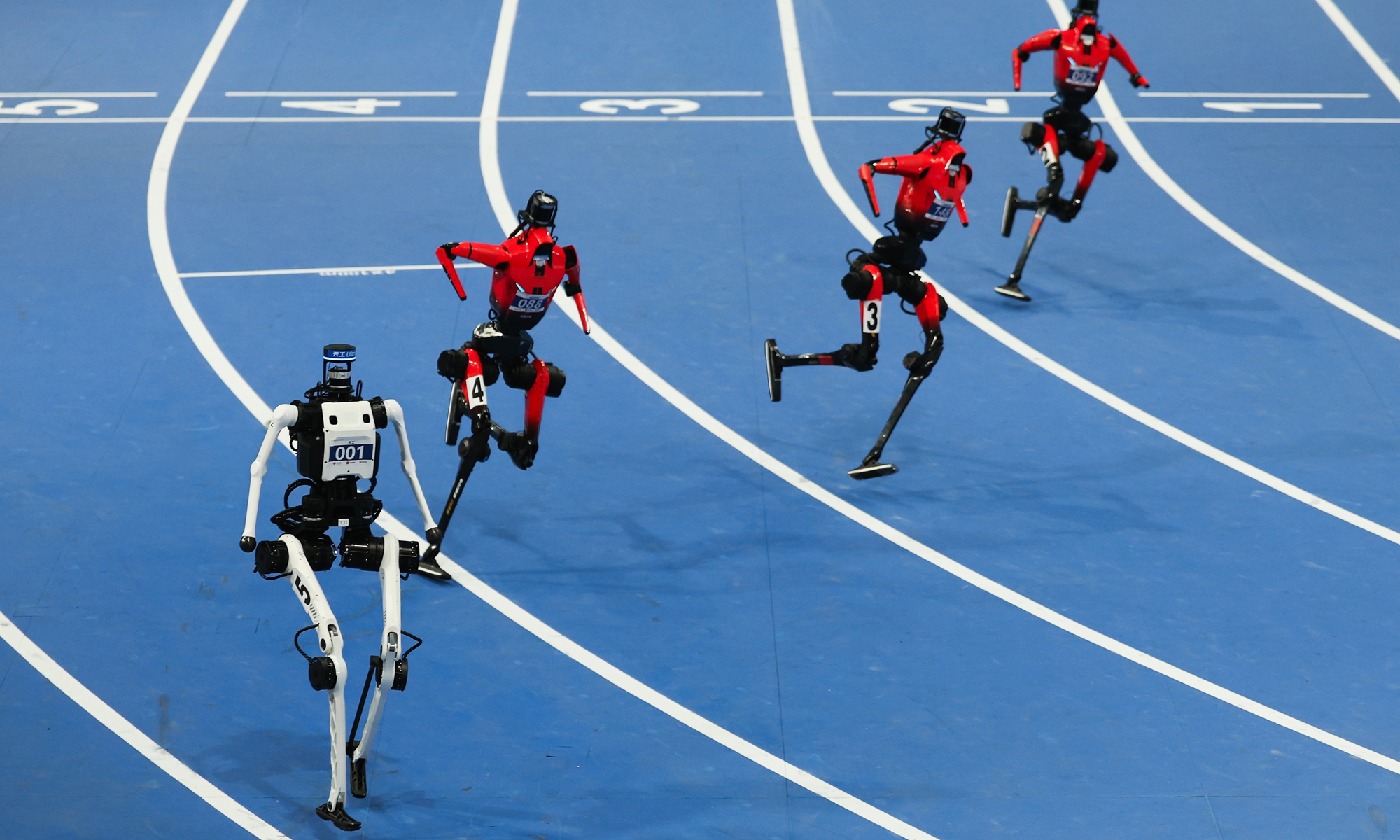
A Tien Kung robot (left) competes in the 400-meter race at the National Speed Skating Oval in Beijing on August 23, 2026 during the 2nd World Humanoid Robot Games (WHRG). Photo: VCG
On the blue track inside the National Speed Skating Oval, robots chased each other in the 400-meter race. A sprinting Tien Kung robot was tripped by a rival robot lying on the track but did not fall. Instead, it adjusted its posture in seconds and continued toward the finish line with a result of 38.15 seconds, breaking human 400-meter race world record of 43.03 seconds, held by South African athlete Wayde van Niekerk.
This scene unfolded on Sunday, the first official competition day of the 2nd World Humanoid Robot Games (WHRG). Later that evening, a humanoid robot named Lightning, developed by Honor Co., broke the long-standing human 1,500-meter world record of 3:26 set by Moroccan athlete Hicham El Guerrouj with a time of 2:30.22. Just one night earlier, during the opening ceremony's 100-meter sprint and high jump demonstrations, humanoid robots had already shattered records long held by human athletes Usain Bolt and Javier Sotomayor — merely an appetizer for the five-day sci-fi spectacle.
The Games have attracted 666 teams from 16 countries across six continents, up 138 percent from its inaugural edition. The number of participating robots quadrupled to 2,056, the Global Times learned from the organizing committee.
Yet the biggest change this year was not only the scale, but also the technological maturity. More teams have shifted from remote-controlled robots to fully autonomous systems. Chinese observers, after watching several events, said humanoid robots are no longer limited to simple demonstrations of walking or dancing. Increasingly, they are being tested in environments that demand speed, coordination, perception and decision-making.
From movement to intelligence
Behind the record-breaking performances are a series of technological upgrades. During the running events, Global Times reporters observed that robots were able to make subtle movements around their hip joints while walking, allowing them to maintain balance and produce movements closer to human biomechanics.
Guo Yijie, technical director of Tien Kung Ultra, said the improvement came from advances in hardware design.
"Robot joints have improved in torque and speed. As competitions demand higher power output, the reliability of the main control board, power board and high-power battery discharge capability have become increasingly important," Guo told the Global Times.
According to Guo, the same Tien Kung Ultra robot was used in both sprinting and jumping events. For running, the waist needs rotation to balance the inertia generated by leg movements. For jumping, the upper body requires pitching movement to help the robot achieve greater distance or height, Guo said, noting that these can all be achieved with only slight adjustments to the waist configuration were needed, and it highly demonstrated to the robot design's flexibility.
Besides the hardware upgrades, developments in robots' faster decision-making in "brains' is better showcased in football competitions.
The Booster T2 robot used by many domestic and overseas football teams has increased its onboard computing capability by 10 times compared with the previous generation. The time from recognizing the goal to deciding whether to pass or shoot has been reduced to around 100 milliseconds - faster than the time humans usually need to blink.
Cheng Hao, a technical representative from Boosters Robotics, said the improvement represents an "end-to-end" transformation in embodied intelligence.
"In the past, robots relied on separate steps: perception, planning, decision-making and execution. Each stage was disconnected. Now, with an end-to-end motion foundation model, visual input can directly generate joint control commands," Cheng said.
The newly introduced table tennis and tennis competitions are also testing another important capability: perception.
"Robots are moving from simply recognizing the three-dimensional position of a ball to understanding the movement information of opponents and more complex environments," said Li Yinghui, a postdoc researcher and the leader from the Hong Kong University team at the table tennis event. Such capabilities developed in sports scenarios could eventually be transferred to other scenarios in industries or daily life, Li said.
Beyond entertainment
Though clips from the robot competitions have made a buzz on social media, with some critics from Western media questioning why robots need to dance, play football or compete in athletics while arguing that these activities appear far from everyday needs.
Zhou Changjiu, Vice President of the RoboCup Federation and the Robotics Competition Association of the Asia-Pacific (RCAP), stressed robot sports are not designed for entertainment alone. "Robot competitions are testing the capabilities needed for humanoid robots to enter the real world," Zhou told the Global Times.
Different events evaluate different abilities. Sprinting tests speed, marathons examine battery endurance and energy management, while football provides a comprehensive test because of its dynamic and unpredictable nature, testing intelligence, manipulation, interaction, safety, cost and trust at the same time, Zhou said.
Unlike a single-task demonstration, football requires robots to cooperate. Players must understand their own roles, recognize teammates and opponents, and make collective decisions - a form of swarm intelligence that could become essential when robots work together in homes, factories and emergency rescue environments.
Entertainment, however, can generate business opportunities. Gu Jinghai, brand director of EYOU Robot Co, told the Global Times that the company sold 95,000 integrated joints in China in 2025 and expects sales to exceed 1 million units in 2026. Growth mainly comes from planetary joints used in entertainment robots, while harmonic joints for industrial robots are also expanding steadily, he said.
Jiao Jichao, an executive from UBTECH Robotics, said the criticism that "Chinese robots can only sing and dance" reflects only a temporary stage of development. "Performance and dancing are also real commercial demands, and their existence has value," Jiao said. "Beyond entertainment, Chinese robots are already demonstrating intelligent capabilities that support practical applications in manufacturing, and partnerships with companies including Huawei and Foxconn, where robots have already entered production lines in small-scale applications."
The Outline of the 15th Five-Year Plan for National Economic and Social Development of China stated that the country will construct a comprehensive cultivation system for future industries including the embody intelligence as new economic growth drivers.
Zhou said the development of humanoid robots is not only about individual machines, but about building an entire ecosystem.
China's advantage lies in its complete supply chain, abundant application scenarios and manufacturing capabilities, while the fast growing industry still faces challenges such as the lack of unified standards.
Gu said the company has launched mass production of robotics joint under domestic standard of auto parts.
Robot competitions can help address these issues by creating common standards in areas such as competition rules, robot dimensions, communication systems, batteries and joint modules. "As applications expand, the cost of key robot components will continue to decline," Zhou said.
"Numbers are magic," Zhou said. "If producing one robot costs a huge amount because it is handmade, producing one million robots will completely change the cost structure."
For humanoid robots, the race taking place inside the Ice Ribbon may not ultimately be about who crosses the finish line first. It may be about whether these machines can learn to navigate the far more complicated race outside the stadium - the race into the real world.
。 CLEVELAND -- The Cleveland Museum of Art has sued New York City authorities over their seizure of a headless bronze statue believed to depict the Roman emperor and philosopher Marcus Aurelius.A warrant signed by a judge in Manhattan on Aug. 14 ordered the seizure of the statue, which the museum acquired in 1986 and had been a highlight of its collection of ancient Roman art. The museum argues in its suit that the statue was lawfully obtained and that Manhattan District Attorney Alvin Bragg’s office has no legal authority to seize it.The warrant was secured as part of an ongoing investigation into a smuggling network involving antiquities looted from Bubon in southwestern Turkey and trafficked through Manhattan, a spokesperson for Bragg has said. The 76-inch (1.9-meter) statue dates from A.D. 180 to 200 and is worth $20 million, according to the district attorney’s office. The suit filed Thursday asks a judge to declare that the museum is the rightful owner of the statue, which it calls “one of the most significant works in the (museum’s) collection” of some 61,000 objects. Museum officials have repeatedly told the district attorney that their evidence is insufficient and suggested other investigative avenues, according to the suit, but all have been refused.The museum said it also has consulted experts who cast “significant doubt” on the identification of the statue as Marcus Aurelius, noting the experts believe it’s more likely a statue of another Greek philosopher.A spokesman for Bragg said the office is reviewing the lawsuit and “will respond in court papers.” He also noted the office has successfully recovered more than 4,600 illegally traffic antiquities.Museum spokesman Todd Mesek said it does not discuss ongoing litigation but noted the museum takes provenance issues very seriously.The statue was removed from view earlier this year, and the museum changed the description of the piece on its website, where it calls the statue a “Draped Male Figure" instead of indicating a connection to Marcus Aurelius.Turkey first made claims about the statue in 2012 when it released a list of nearly two dozen objects in the Cleveland museum’s collection that it said had been looted from Bubon and other locations. Museum officials said at the time that Turkey had provided no hard evidence of looting.The Manhattan district attorney’s office has worked in recent years to repatriate hundreds of objects looted from countries including Turkey, Greece, Israel and Italy. It was unclear who might be targeted in the investigation of the statue seized in Cleveland.Marcus Aurelius ruled as Roman emperor from A.D. 161 to 180 and was a Stoic philosopher whose “Meditations” have been studied over the centuries.The seized statue shows a man in flowing robes holding one hand in front of him in a regal pose.。
Current article:http://ycda0m.minshixuanhabing.bond/mshdtd0/boabe35.html
Published on:13:42:47
下一篇:国内期市早盘开盘燃料油跌近7% 上一篇:来抚客商参观考察抚顺运动地板产业


1
山西省洪洞县农商行原董事长郭宏伟被遣返回国2
订单排到第四季度!国产叉车 全球爆单→,订单排到第四季度!国产叉车 全球爆单→3
台风“白海豚”在浙江台州玉环沿海登陆4
美军在加勒比海打击“贩毒船”致4人死亡5
GT Voice: Chinese investment could help Germany stabilize its talent base6
卡尔:约基奇本可成历史前十 却被掘金耽误了7
国家发改委紧急安排1亿元支持西藏吉隆泥石流应急恢复8
家人齐努力 日子更红火9
Schumer says he's leading a bipartisan group of senators to Israel10
‘이준석 지도부’ 사퇴…개혁신당 2년 7개월여 만에 존립 ‘흔들’11
외국인 비중 70%…롯데호텔, ‘K-트래블’ 혜택 강화12
전국 국·공립대, 교육교부금 개편 찬성…교육청과 온도차13
Rashmika Mandanna and Ayushmann Khurrana Starrer Thamma Releases on OTT14
JetBlue plane tilts back after landing at JFK Airport but no injuries reported15
“穿越火线HD”PVE模型预测:芬兰开发商补救生产,将开启关闭测试
- 随机推荐
1
Oscars 2025 Full Winners List: Anora, The Brutalist Win Top Honours2
更强大!谷歌FI运营商服务推出下一代短消息功能rcs3
Police in Belgium say 2 people have been killed in a shooting in Brussels4
$1.4 million speeding ticket surprised man before officials clarified situation5
字母哥畅谈节日心境 赛场远比居家过节更心动6
Haynes:因场上冲突时没有去帮队友 波尔被布登DNP到赛季结束7
特朗普:不会放弃对伊朗的军事选项;伊朗:为保守军事机密,部分装备系统暂未对外展示8
“安装模拟器”将在测试后一个月底正式发布。将来,它将被添加到Nvidia RTX系列图形卡中。9
A shutter click reunites cross-Strait kin separated for decades10
小米官方确认:彭超芯片还在开发中11
Brunei Sultan Haji Hassanal arrives on 3-day visit to B'desh12
神十八点火瞬间航天员齐刷刷敬礼 这个画面太珍贵了13
Defiant Taiwan moving away from China14
CII another blow for media ahead of national polls: B’desh Journalist Leaders15
国家统计局:8月上旬流通领域重要生产资料31种产品价格下降